

By Sammy Miles, Managing Editor-in-Chief of CORROSION journal
On Wednesday at AMPP 2026, panelists from different branches and offices of the U.S. military came together to provide updates on their corrosion policies.
The first presentation was given by Paul Chang, Director of the Department of War’s Office of Corrosion Policy and Oversight. His focus is on new technologies and developing the workforce — particularly contractors for shipyards, and working with the Institute for Defense Analyses (IDA) to provide studies.
Other areas he highlighted were incorporating more thermal spray nonskid through the Naval Research Laboratory; zinc-rich primer standardization; and overhauling the Defense Logistics Agency’s paint order supply chain.
The second presentation — given by Meghan McGinley, Support to the Army Corrosion Control and Prevention Executive — provided highlights of the Army’s corrosion programs. Some of the areas they are working on include regulation and policy reviews; issuing corrosion action memorandums (CAMs); facilitating multiple working groups; and creating a guidebook for acquisition professionals.
The Army is exploring new ways to measure the impact of corrosion in actionable ways and considering new and modified data sources. Several success stories were shared, such as applying coating to address pitting on nozzles, which led to a reduction in corrosion. Another success story involved switching to a light-weight cold spray system, which reduced lead time from 47 months to 316 hours.
Tony Zambrano, Marine Corps CPAC Program Team Lead, shared the four pillars of Corrosion Prevention and Control (CPAC): assessments; research, development, test, and evaluation (RDT&E); prevention; and repair. The data presented showed savings reductions (for example, $20 million savings by moving from a standalone facility to a mobile enhancement team), as well as significant drops in severe corrosion damage in assets (from 71% with significant damage in 2004 to 6% in 2026).
The final presenter was Casey Jones, Support to the Air Force Corrosion Executive. He shared that 20% of their maintenance cost was due to corrosion. Some of the corrosion mitigation and prevention technologies the Air Force uses include lasers, carbon dioxide (CO₂) blasting, atmospheric plasma, non-chromated coatings, corrosion sensors, and metallic plating.
Jones cited challenges in the adoption of new technologies due to economic and financial barriers; technical and performance risks; a lack of awareness and training; resistance to change; and supply chain and logistical issues.
 In 2026 Keynote, Former Blue Angels Pilot to Share Lessons in Precision
Whether you’re a naval aviator or a materials protection professional, small decisions can have big consequences. That’s the message former Blue Angels pilot John “Gucci” Foley plans to share as the keynote speaker at AMPP’s 2026 Annual Conference + Expo.
Read more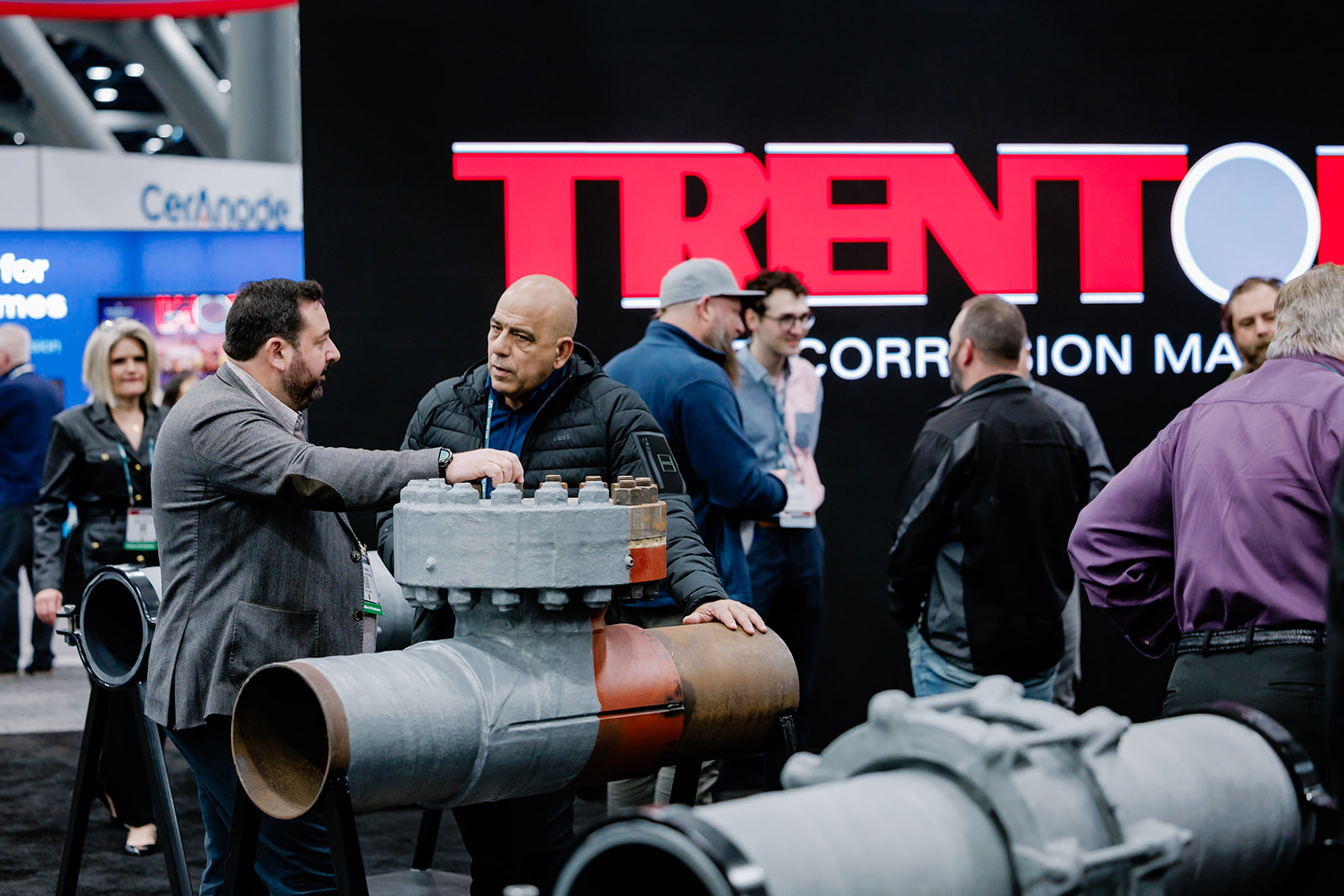 Exhibit Hall Is Open for Business at AMPP 2026
The Exhibit Hall at the 2026 AMPP Annual Conference + Expo is now open! The ceremonial ribbon cutting by Alan Thomas, CEO of AMPP, took place on Monday afternoon inside Houston’s expansive George R. Brown Convention Center.
Read more AMPP Honors Next Generation at Scholarship Awards, EMERGing Leaders Bash
The Scholarship Awards featured BP as its signature sponsor, while the Emerging Leaders Bash had Sherwin-Williams as its signature sponsor and the International Union of Painters and Allied Trades (IUPAT) and the AMPP Arizona Chapter as copper sponsors.
Read more